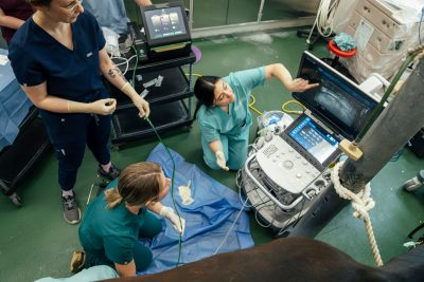
Photo: MSU Veterinary Medical Center
“See one, do one, teach one” is a common saying and learning approach in veterinary medicine. It essentially means, observe an expert performing a task, practice this task under the guidance and supervision of someone more experienced, and, once you’ve established competency, teach the task to a less experienced learner.
While the “see one, do one, teach one” learning approach isn’t a part of Vygotsky’s teachings, I did see some connections between this familiar veterinary teaching approach and several concepts within Vygotsky’s Sociocultural Learning Theory.
Lev Vygotsky was a Russian psychologist who viewed learning as a social process. He believed that learning occurred through social interactions with others. He suggested that cognitive growth is shaped through interactions with our society and people that have more knowledge than the learner, such as parents, peers and teachers (Cherry, 2025).
One of Vygotsky’s central ideas was that of the More Knowledgeable Other (MKO) (Cherry, 2024). The MKO is someone with more knowledge or experience in a particular field and who is able to support and guide a learner as they develop new knowledge and skills. The MKO might be peers, instructors, or more experienced community members that share their knowledge with the learner.
Vygotsky also discussed the Zone of Proximal Development. This is the gap between what a learner can do on their own and what they can do with guidance from someone more knowledgeable (Vygotsky, 1978) and (Cherry, 2023). Through social interactions and scaffolding, or temporary support provided to the learner, the learner can gradually move towards greater independence.
When I think about the “see one, do one, teach one” approach through this lens, I can see how each step illustrates Vygotsky’s theory.
See one: The learner observes someone more knowledgeable performing a task in a social and contextual environment.
Do one: The learner works through their Zone of Proximal Development with guidance and support while the scaffolding is gradually removed, allowing the learner to complete what they once were not capable of performing.
Teach one: Once the learner has developed the knowledge and skills, they can now guide and support someone with less experience. They now become the More Knowledgeable Other for another less experienced learner.
Vygotsky’s Sociocultural Learning Theory made me wonder about the order in which we teach our veterinary nursing students.
Currently, our students begin their curriculum in the classroom where they are introduced to foundational knowledge and concepts. As they progress through the curriculum, we begin helping them to transfer their knowledge to models and eventually to live animals. Their final year is spent on the clinic floor working side by side with veterinary students, senior veterinary nurses, doctors, and clients.
Students seem to get more energized once they start working with live animals on the clinic floor. Here they are working with real patients, with real problems, surrounded by real members of the veterinary team. They are connecting their knowledge and skills and seeing how they actually fit into their chosen profession.
So, I wondered:
Why do we wait until the end of their curriculum to create this social, contextual experience for our students? Instead, I wonder what would happen if we flipped the order of their curriculum.
What if students were allowed to observe and interact alongside veterinary professionals in the clinic BEFORE the end of their formal classroom knowledge?
This doesn’t mean we no longer engage students in a didactic classroom setting. Veterinary nursing is a hands-on profession where knowledge, skills, safety and evidence-based decision making are essential.
Could earlier access to the clinic floor and interactions with real veterinary professionals (MKOs) help our student learners grasp a better understanding of their future profession?
Could this provide a richer dialogue between the teacher and the student learner once they reach the classroom where foundational knowledge was then introduced? Students would then have more to talk about, have more questions to ask and have made more connections.
Vygotsky’s Sociocultural Learning Theory has made me think about the structure of our current veterinary nursing curriculum. If students become more engaged and make stronger learning connections when surrounded by people and experiences that are real, perhaps we need to move our “see one, do one, teach one” earlier in our students’ learning.
References:
Vygotsky, L.S. (1978) Interaction between learning and development in M. Cole, V. John-Steiner, & E. Souberman (Eds.) Mind in Society: The development of higher psychological processes (pp. 79-91). Harvard University Press
Cherry, K. (2023, July 6). How Vygotsky defined the Zone of Proximal Development. verywell mind.
https://www.verywellmind.com/what-is-the-zone-of-proximal-development-2796034
Cherry, K. (2025, February 7). Lev Vygotsky’s life and theories. verywell mind.
https://www.verywellmind.com/lev-vygotsky-biography-2795533
Cherry, K. (2024, July 12). What is sociocultural theory? verywell mind.
https://www.verywellmind.com/what-is-sociocultural-theory-2795088